

Scope, current regulations, and operation of the LEZ
Content index:
- What is the LEZ?
- Why a Low Emission Zone in Oviedo?
- How does Oviedo’s LEZ work?
- Which areas of the city are affected?
- What regulations apply to each ring?
- When will it come into effect?
- What are environmental labels?
- How do I know which environmental label my vehicle has?
- Is it necessary to place the label on the vehicle?
- I don’t have a label. Can I access?
- How is LEZ access controlled?
- Where and how to park in the LEZ?
What is the LEZ?
A Low Emission Zone (LEZ) is a geographically defined area aimed at reducing air and noise pollution, thereby improving citizens’ quality of life. It promotes the use of public transport, walking, and micromobility through bicycles and personal mobility vehicles (PMVs). It also seeks to optimize the management of Urban Goods Distribution.
Why a Low Emission Zone in Oviedo?
Law 7/2021, of May 20, on Climate Change and Energy Transition, establishes in Article 14 that all Spanish municipalities with more than 50,000 inhabitants must adopt Sustainable Urban Mobility Plans (PMUS) that include measures to reduce transport emissions, including the creation of Low Emission Zones (LEZ).
This action is a mitigation measure that will reduce emissions from mobility.
Oviedo is working on implementing its Low Emission Zone through the “Aid program for municipalities for the implementation of low emission zones and the digital and sustainable transformation of urban transport”, within the Recovery, Transformation and Resilience Plan – Next Generation EU (Government of Spain, 2020).
How does Oviedo’s LEZ work?
Oviedo’s Low Emission Zone (LEZ) organizes the city center into two rings with different levels of traffic restriction. Access and circulation in each ring depend on the DGT environmental label of each vehicle.
The most polluting cars will have progressive limitations to enter the most sensitive areas. The goal is to improve air quality and urban mobility, benefiting all citizens.
The LEZ regulation is designed with a progressive and adaptive approach, allowing the population enough time to adjust to the new access conditions. This gradual implementation minimizes the impact on Oviedo residents’ mobility, economic activity, and local commerce, facilitating an orderly transition to a more sustainable mobility model.
The start of each phase of the project will be announced in advance through this website and all our communication channels.
Which areas of the city are affected?
Oviedo’s Low Emission Zone covers the city center, including the historic quarter and the entire central area within the ring road.
Territorially, regulation is carried out by dividing two distinct areas:
-
INNER RING. Delimited by the following streets:
Adelantado de la Florida, Postigo Bajo, Postigo Alto, Padre Suárez (between Postigo Alto and Marqués de Gastañaga), Marqués de Gastañaga, Campomanes, Santa Susana, Conde de Toreno, Uría, Doctor Casal, Melquiades Álvarez, Covadonga, Manuel García Conde, and Víctor Chavarri. -
OUTER RING. Delimited by the following streets:
General Elorza, Adelantado de La Florida, Ronda Sur, Muñoz Degraín, González Besada, Padre Vinjoy Avenue, Hermanos Menéndez Pidal Avenue, Real Oviedo, Independencia, and Santander Avenue.
It is important to note that the streets listed above, which delimit each contour, will not be included within the regulation of the corresponding ring, while the inner streets will be.
What regulations apply to each ring?
Initially, regulation will affect vehicles without an environmental label (or with category A), which will have limited access to the inner ring from 2026, and to the outer ring from 2028. However, vehicles without a label may still access if they park in a public parking lot or are included among the exempt groups (such as residents, merchants, people with reduced mobility, and others provided for in the Ordinance).
-
Inner ring regulation:
In this LEZ ring, access, circulation, and parking of motor vehicles defined by state regulations as the most polluting are prohibited, as established in the following table.Period Type of vehicle From 31/12/2025 Vehicles without environmental label -
Outer ring regulation:
In Oviedo’s LEZ, access, circulation, and parking of motor vehicles defined by state regulations as the most polluting are prohibited, as established in the following table.Period Type of vehicle From 31/12/2027 Vehicles without environmental label
When will it come into effect?
The implementation of the LEZ is integrated and consistent with municipal strategic urban planning instruments and air quality and noise action regulations, as well as measures adopted by the Sustainable Urban Mobility Plan (PMUS).
The LEZ will be permanent and will be implemented through a phased calendar to allow citizens and economic sectors to gradually adapt to its characteristics.
Specifically, the first key date will be January 1, 2026, when the restriction for driving with the corresponding label will affect the inner ring, which includes the historic quarter and the main commercial area. From January 1, 2028, this regulation will extend to the entire center, within the ring formed by the Inner Ring.
An informative period will begin so that citizens can learn about and adapt to the new LEZ access rules. Only after this informative process will the new LEZ usage regulations officially come into force.
The start of each of these phases will be announced in advance through this website and all our communication channels.
What are environmental labels?
The environmental labels from the Directorate General of Traffic (DGT) classify vehicles according to their energy efficiency, helping to assess their environmental impact.
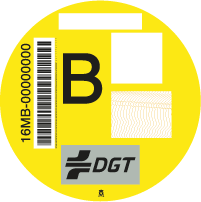
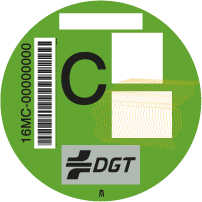
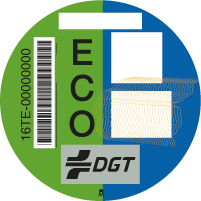
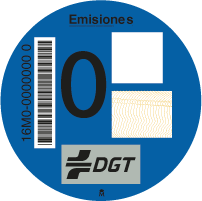
Currently, there are 4 different labels: 0, ECO, C, and B.
- The 0 emissions environmental label, blue in color, identifies the most efficient vehicles as they do not emit polluting gases. Vehicles with this label include battery electric cars (BEV), extended-range electric vehicles (REEV), plug-in hybrid electric vehicles (PHEV) with a range of more than 40 km, or fuel cell vehicles.
- ECO environmental label: plug-in hybrid cars with a range of less than 40 km, non-plug-in hybrids (HEV), vehicles powered by natural gas and gas (CNG and LNG) or liquefied petroleum gas (LPG).
- C environmental label, green in color: this label is reserved for internal combustion engine vehicles that meet EURO emissions standards. Gasoline cars and light vans registered from January 2006 and diesel from September 2015.
- B environmental label, yellow in color: this label is for gasoline cars and light vans registered from January 1, 2001, and diesel from 2006.
Vehicles not included in any of these classifications are not entitled to any type of label.
How do I know which environmental label my vehicle has?
Oviedo City Council offers a license plate search tool. By simply entering your vehicle’s license plate, you can immediately find out which DGT environmental label applies (0, ECO, C, B, or none).
This label determines the access and circulation conditions within the Low Emission Zone (LEZ).
Is it necessary to place the label on the vehicle?
No. It is not necessary to display the environmental sticker on the windshield.
LEZ access control will be carried out automatically through the license plate, which is linked to the DGT environmental label in the database.
I don’t have a label. Can I access?
For vehicles with restricted access, there are certain cases in which these vehicles may still enter the LEZ, such as those parking in a public parking lot, or those included among the exempt groups (such as residents, merchants, people with reduced mobility, vehicles transporting dependent persons, and other cases provided for in the Ordinance), provided they are registered in the municipal authorized vehicles platform for the LEZ.
Authorizations granted to vehicles registered on the mentioned platform will be time-limited, and may be continuous or discontinuous, referring to months, days, and hours.
The City Council will publish through various channels the procedures for requesting authorizations to access the LEZ in extraordinary cases. Likewise, all cases with exemptions for accessing the LEZ for vehicles without an environmental label will also be published.
How is LEZ access controlled?
Access will be regulated by an automatic system connected to a municipal technology platform, which will check whether each vehicle can enter the LEZ.
Control will be carried out with cameras and image capture systems, always complying with road safety and data protection regulations.
All technological management will be carried out in accordance with the Data Protection Law to guarantee citizens’ rights.
Where and how to park in the LEZ?
Within the LEZ, there will be regulated and reserved parking areas according to use (residents, loading and unloading, services, etc.). These areas will be clearly marked and may be permanent or operate only at certain times or days.
Usage control will be carried out using electronic or technological systems, which allow monitoring how long each vehicle occupies the space and ensure compliance with maximum times. Only vehicles authorized under municipal regulations may park in each area.
There will be exceptions and special permits for residents, workers, essential services, or economic activities.